
Flexible, scalable heating and cooling solutions designed to simplify installation, improve energy efficiency and support a wide range of commercial and industrial applications.
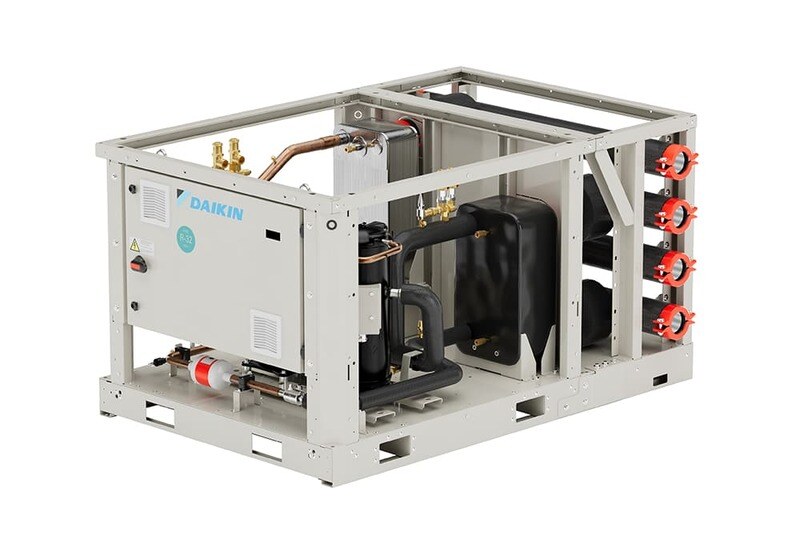
Daikin has expanded its HVAC portfolio with the introduction of the EW*T-Q-X-A1 modular water-to-water heat pump range, featuring Daikin-designed scroll compressors.
First introduced in April 2024, the range offers a flexible alternative to traditional packaged systems, allowing multiple smaller units to be connected and controlled as a single system to meet specific heating and cooling requirements.
The modular design simplifies transportation, handling and installation, while providing the flexibility to expand system capacity as building requirements change. When combined with Daikin's dedicated Manifold Kit and Pump Module, the range also offers a streamlined, plug-and-play installation solution.
Flexible Heating and Cooling for Multiple Applications
Designed to accommodate a wide range of operating conditions, the EW*T-Q-X-A1 range provides reliable heating and cooling performance across commercial, industrial and process applications.
The system can produce hot water at temperatures of up to 60°C, while chilled water can be supplied at leaving water temperatures ranging from -15°C, using a water-glycol mixture, to +30°C.
This operating flexibility makes the range suitable for applications including comfort heating, space cooling, process cooling and heat recovery.
The range is available in three base module capacities:
- 100 kW
- 125 kW
- 160 kW
Two sound versions are available, including a reduced-sound option suited to noise-sensitive environments such as hotels, hospitals and residential developments.
To accommodate different system requirements, the range offers three configurations:
- Water-to-water heat pump with waterside inversion
- Water-to-water heat pump with refrigerant-side inversion (100 kW model only)
- Condenser-less configuration
The Benefits of Modular Heat Pump Technology
1. Scalable Capacity for Changing Building Requirements
One of the key advantages of the EW*T-Q-X-A1 range is its modular design, allowing heating and cooling capacity to be tailored to individual project requirements.
Rather than investing in a larger packaged system from the outset, building owners can install the capacity required initially, with the option to introduce additional modules as demand increases.
This approach can help reduce initial investment costs while providing greater flexibility for future expansion.
Modules can be installed side by side or stacked to minimise the overall system footprint, making the range particularly suitable for retrofit projects and installations where plantroom space is limited.
2. Compact Design for Easier Installation
The compact dimensions of each module simplify transportation, positioning and installation, particularly within existing buildings where access may be restricted.
Measuring approximately 1,200 mm wide, 1,300 mm deep and 1,000 mm high, each module can be handled individually using a forklift, reducing the need for larger lifting equipment associated with traditional packaged chillers.
This compact construction can help overcome installation challenges while reducing disruption during refurbishment and replacement projects.
3. Simplified Plug-and-Play Installation
The EW*T-Q-X-A1 range has been designed to streamline installation through the use of dedicated accessories.
Daikin's Manifold Kit connects multiple modules on the water side, incorporating the necessary interconnecting pipework and manual isolation valves.
These valves allow individual modules to be isolated for maintenance without requiring the entire system to be shut down, supporting improved serviceability and operational continuity.
A dedicated Pump Module can also be integrated into the system. Equipped with inverter-driven pumps and an 18-litre expansion tank, it provides additional installation flexibility while simplifying the overall hydraulic arrangement.
Together, these components help reduce installation complexity and support a more efficient commissioning process.
4. Improved Efficiency and Lower Operating Costs
The modular configuration allows the system to respond more closely to changing heating and cooling demands.
As building loads fluctuate throughout the day and across the seasons, individual modules can be managed to match the required capacity.
This is particularly beneficial during part-load operation, which accounts for a significant proportion of the operating time of many HVAC systems.
By matching output more closely to demand, the system can reduce unnecessary energy consumption and limit inefficient on-off cycling, helping building operators manage long-term operating costs.
5. Flexible Maintenance and Future Expansion
Modularity also provides practical advantages throughout the equipment's operational life.
The ability to isolate individual modules supports maintenance activities while allowing the remaining modules to continue operating, subject to available system capacity.
Additional modules can also be incorporated as requirements evolve, helping building owners adapt their HVAC systems without necessarily replacing the complete installation.
This flexibility makes modular technology an attractive option for projects where long-term adaptability, maintenance access and operational reliability are key considerations.
Supporting Energy Efficiency and Reduced Environmental Impact
Alongside installation flexibility, Daikin continues to focus on improving the environmental performance of its heating and cooling technologies.
The EW*T-Q-X-A1 range uses R-32 refrigerant, which has a Global Warming Potential (GWP) of 675, approximately one-third that of R-410A.
Combined with efficient system operation and the ability to match output to actual demand, R-32 technology can help reduce the environmental impact associated with HVAC systems.
The lower refrigerant charge requirements associated with R-32 can also provide benefits in terms of installation and servicing.
By combining modular flexibility with energy-efficient technology, the range supports building owners and operators seeking to improve system performance while managing energy consumption and long-term operating costs.
A Flexible Approach to Modern HVAC Systems
As commercial and industrial buildings face increasing demands for energy efficiency, flexibility and reliable performance, modular HVAC solutions offer an alternative to conventional packaged equipment.
The Daikin EW*T-Q-X-A1 range combines scalable capacity, compact dimensions and simplified installation with the operational benefits of modular system control.
Whether specified for a new development, an existing building refurbishment or a process cooling application, the range provides a flexible solution designed to accommodate changing heating and cooling requirements.
Discover Daikin Applied (UK)'s range of energy-efficient chillers and heat pumps and explore the solutions available for your next project.
Explore Our Chillers and Heat Pumps